
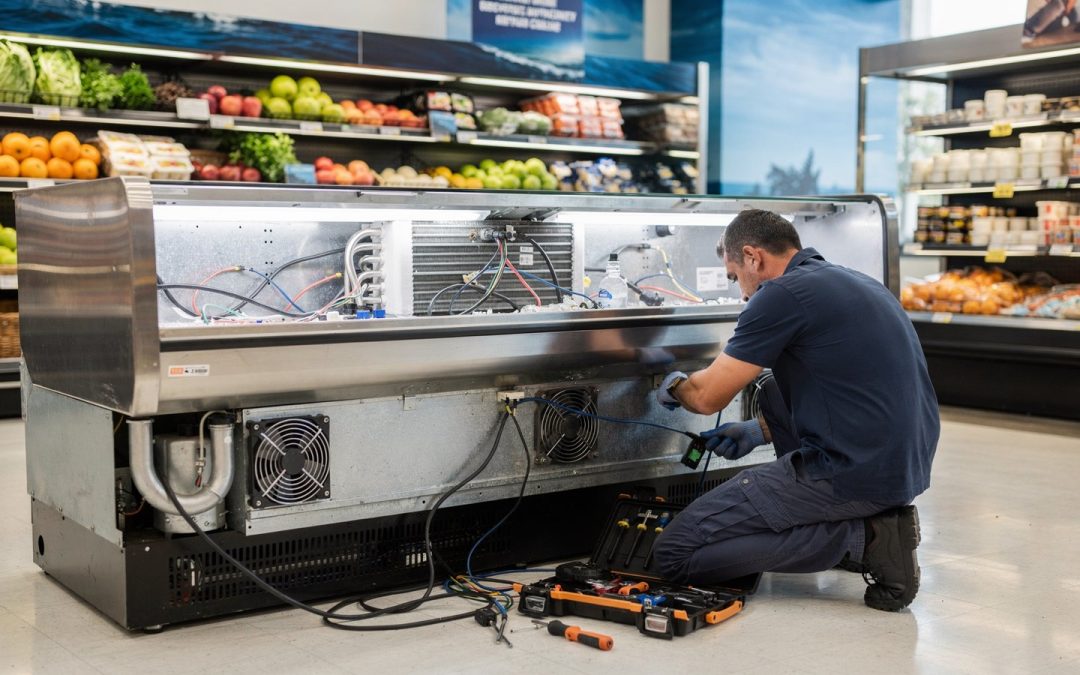
Grocery store refrigeration repair San Diego grocers depend on is its own kind of urgent — open cases, walk-ins, and freezers running around the clock, with thousands of dollars of product behind every door. Coast 2 Coast Refrigeration provides commercial refrigeration repair for grocers, markets, and food retailers across San Diego County, with fast response when a case or cooler goes down.
Why Grocery Refrigeration Is Different
A restaurant has a walk-in or two. A grocery store has rows of open display cases, multiple walk-ins, reach-in freezers, and often a refrigerated prep area — all running continuously and all stocked with perishable inventory. The scale changes everything. A single failed case can mean a five-figure loss before anyone notices the temperature climbing.
Open refrigerated cases also fight a constant battle against ambient air, foot traffic, and door openings. They depend on clean coils, healthy fans, and tight controls to hold temperature. A store also can’t simply shut down to make a repair the way a restaurant can close for a night — the doors stay open and the product keeps moving, so repairs have to happen around a live operation. Our overview of the top things to know about grocery store refrigeration covers the basics every store owner should understand.
The Holiday-Season Stakes
November and December are the highest-stakes months of the year for food retail. Stores carry more inventory, move more volume, and run their refrigeration hardest right when a failure would hurt most. A walk-in that quits the week of a holiday isn’t an inconvenience — it’s a major loss and a scramble to protect product.
That’s exactly why this is the season to make sure your equipment is solid. A small problem ignored in October becomes an emergency in December, when service demand peaks and every hour of downtime costs more.
Food Safety and the Temperature Line
For a grocer, temperature is the law. The FDA Food Code requires cold-holding at 41°F or below, and the USDA identifies 40°F to 140°F as the “Danger Zone,” where bacteria can double in as little as 20 minutes.
When a case drifts warm, you’re not just risking spoilage — you’re risking a health-department problem and a recall of product from your shelves. Holding the temperature line is non-negotiable, and it starts with equipment that’s maintained and repaired promptly.
Common Grocery Refrigeration Problems We Repair
Most grocery service calls trace to a familiar set of issues:
- Dirty condenser coils — the top cause of rising temperatures and runaway energy costs.
- Failed evaporator or case fans — uneven cooling and warm spots in display cases.
- Refrigerant leaks — gradual loss of cooling that worsens until the case can’t hold temperature.
- Compressor failure — the most serious repair, often hitting older racks and cases hardest.
- Defrost and control faults — ice buildup and erratic temperatures that look worse than the actual fix.
Freezers bring their own challenges; our piece on fast walk-in freezer repair covers the freezer side in detail.
Schedule Service Today and get your refrigeration checked before the holiday rush.
Emergency Response and Your Inventory
When refrigeration fails, the clock starts. The USDA notes that refrigerated food stays safe only about four hours once cooling stops, and a full freezer holds roughly 48 hours if the door stays closed. Those windows decide whether you save the product or write it off.
That’s why response time is everything for a grocer. We prioritize refrigeration emergencies and move fast to get cases and walk-ins back to temperature before your inventory crosses the line. When we arrive, the first job is often to stabilize and protect product — then diagnose and repair — so a fixable fault doesn’t turn into a total inventory loss. If a unit is already warming, our guide on a commercial refrigerator not holding temperature outlines the first steps.
Preventive Maintenance Keeps Stores Running
The cheapest grocery repair is the one you prevent. According to ENERGY STAR, clean coils and good airflow can save an average food facility close to a thousand dollars a year — and that same maintenance is what stops mid-holiday breakdowns. Regular service on coils, fans, seals, and controls keeps your cases efficient and reliable. See the full range of work we handle across our services.
Serving San Diego Grocers & Markets
From neighborhood markets to full-size grocery stores, we service food retailers across San Diego County — including Chula Vista, National City, El Cajon, La Mesa, and Escondido. See every area we cover on our service areas page. Local, fast response is what protects your inventory when a case goes down.
Frequently Asked Questions
How fast can you respond to a grocery refrigeration emergency?
We prioritize refrigeration failures and offer same-day and emergency response across San Diego County. Call us with the symptoms and we’ll move quickly to protect your product.
How long is my product safe if a case or walk-in fails?
The USDA says refrigerated food is generally safe for about four hours after cooling stops; a full freezer holds around 48 hours if kept closed. Fast repair is what keeps you inside those windows.
How much does grocery store refrigeration repair cost in San Diego?
It depends on the unit and the fault, from a fan or coil service to a compressor replacement. We provide a diagnosis and written estimate before any work begins.
Do you offer maintenance plans for stores?
Yes. Scheduled maintenance on your cases, walk-ins, and freezers prevents most breakdowns and keeps energy costs down. We’ll build a plan around your equipment.
Ready to Get Started?
Don’t let a failed case cost you the holiday season. Coast 2 Coast Refrigeration keeps San Diego grocers cold, compliant, and running.
Schedule Service Today or call us at (619) 288-3842.